 手机版
手机版






The Maillard reaction is named after the French scientist Louis Camille Maillard (1878-1936), who studied the reactions of amino acids and carbohydrates in 1912, as part of his PhD thesis, which was published in 1913 (reference 1).

Maillard
The Maillard reaction is not a single reaction, but a complex series of reactions between amino acids and reducing sugars, usually at increased temperatures. Like caramelization, it is a form of non-enzymatic browning.
In the process, hundreds of different flavour compounds are created. These compounds in turn break down to form yet more new flavour compounds, and so on. Each type of food has a very distinctive set of flavour compounds that are formed during the Maillard reaction.
Maillard reactions are important in baking, frying or otherwise heating of nearly all foods. Maillard reactions are (partly) responsible for the flavour of bread, cookies, cakes, meat, beer, chocolate, popcorn, cooked rice. In many cases, such as in coffee, the flavour is a combination of Maillard reactions and caramelization. However, caramelization only takes place above 120-150 °C, whereas Maillard reactions already occur at room temperature.
Although studied for nearly one century, the Maillard reactions are so complex that still many reactions and pathways are unknown. Many different factors play a role in the Maillard formation and thus in the final colour and aroma; pH (acidity), types of amino acids and sugars, temperature, time, presence of oxygen, water, water activity (aw) and other food components all are important.
The first step of the Maillard reaction is the reaction of a reducing sugar, such as glucose, with an amino acid. This reaction is shown in figure 1 below and results in a reaction product called an Amadori compound.

Fig. 1 : The initial step of the Maillard reaction between glucose and an amino acid (RNH2), in which R is the amino acid side group (from ref. 2)
As can be seen in figure 1, the Amadori compounds easily isomerise into three different structures that can react differently in the following steps. As in food generally over 5 different reactive sugars and 20 reactive amino acids are present, only the first step theoretically already results in over 100 different reaction products.
The larger the sugar, the slower it will react with amino acids. The pentose sugars (5 carbon atoms), such as ribose, will react faster as hexose sugars (glucose, fructose) and disaccharides (sugar, lactose). From the amino acids lysine, with two amino groups, reacts the fastest and causes darker colours. Cysteine, with a sulphur group, causes specific flavours, but less colour. Sugar alcohols or polyols (sorbitol, xylitol) do not participate in the Maillard reaction. This means that bakery products sweetened with sorbitol will not or hardly change colour during baking.
The next steps differ, depending on the isomer of the Amadori compound. Either the amino acid is removed, which results in reactive compounds that are finally degraded to the important flavour components furfural and hydroxymethyl furfural (HMF). The other reaction is the so-called Amadori-rearrangement, which is the starting point of the main browning reactions, see figure 2.

Fig. 2 : Formation of HMF and Amadori-rearrangement (from ref 2)
Furfural and hydroxymethylfurfural are characteristic flavour compounds of the Maillard reaction. Furfural is the result of a reaction with a pentose sugar (such as ribose); HMF is the result of a reaction with a hexose (glucose, saccharose).
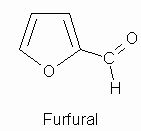
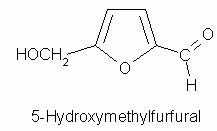
Fig. 3 : Structures of fural and HMF
After the Amadori-rearrangement three different main pathways can be distinguished :
- Dehydratation reactions,
- Fission, when the short chain hydrolytic products are produced, for example diacetyl and pyruvaldehyde,
- “Strecker degradations” with amino acids or they can be condensated to aldols.
These three main pathways finally result in very complex mixtures, including flavour compounds and brown high molecular weight pigments melanoidins.
Melanoidins are present in many foods like coffee, bread and beer. However, up to now the knowledge about structural, functional and physiological properties of this group of food components is rather limited.
The Maillard reaction products thus change the colour and flavour of food, and in most cases these changes are appreciated by people. In addition the melanoidins may have some beneficial anti-oxidant properties.
On the other hand, Maillard reactions may reduce the nutritional value of a product, as amino acids and carbohydrates may be lost. Sometimes the flavour is not appreciated, such as the ‘cooking flavour' in sterilized milk.
Some of the Maillard end-products may also be toxic or carcinogenic. One of the Maillard reaction products is acrylamide, a potential toxic compound which is only formed at temperatures above 180 °C, especially in baked or fried products (French fries). When frying below 180 °C acrylamide is not formed.
In general it can be stated that Maillard products have been present in our foods for many thousands of years, and are consumed daily by nearly all people in the world.


